
Singapore sits so close to the equator that sunrise barely moves through the year, usually landing somewhere around 7 am, with sunset around 7 pm. That predictability is handy for planning your day, but it also means early light arrives at much the same time every morning, whether you’re ready for it or not. Add bright streetlights, neighbouring blocks and late nights, and it’s easy to see why so many homes now use two layers at the window: a sheer for daytime and a heavier curtain for night. Getting that pairing right is where custom curtains make a real difference.
One Track for Light, One for Darkness
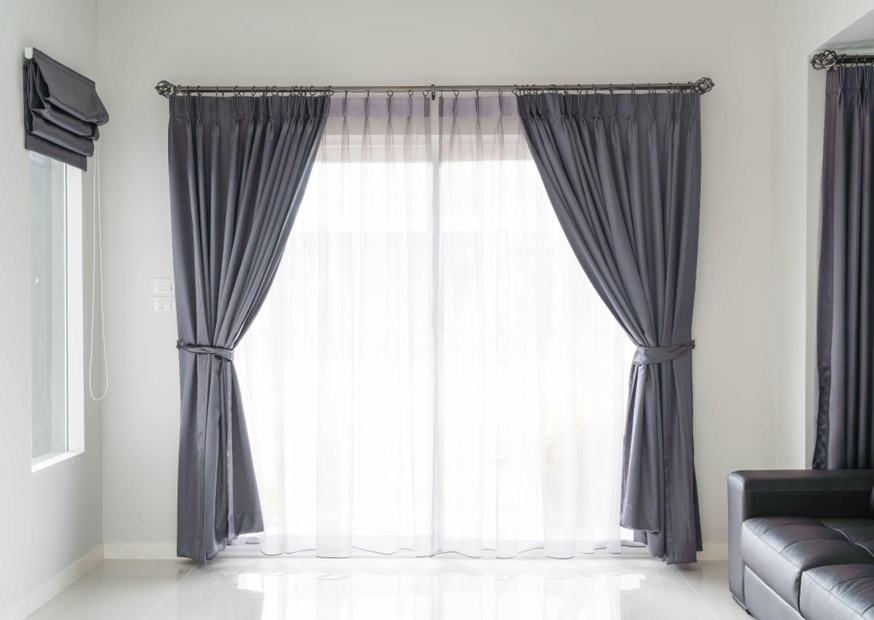
A double track holds two curtains side by side, usually a sheer on one rail and an opaque curtain on the other. During the day, the sheer filters sunlight and gives some privacy while keeping the room bright. At night, the heavier layer closes over it for darkness and privacy.
The setup sounds simple, but the details matter. The two curtains need enough space between the tracks so they don’t snag, matching heights so the hems line up, and colours that look intentional when either layer is drawn. Off-the-shelf panels rarely fit a double track perfectly, which is why a custom curtain made to your window’s exact width and drop usually sits more neatly.
Blackout, Dim-Out or Sheer: Which Layer Does What?
Not every room needs total darkness, so it helps to know what each fabric is built for before choosing:
| Fabric type | What it does | Suits |
| Sheer | Softens daylight and offers daytime privacy | Living rooms, dining areas, any room by day |
| Dim-out | Reduces light noticeably while letting a little through | Bedrooms where some morning light is welcome |
| Blackout | Blocks most light from passing through the fabric | Bedrooms, nurseries, home cinemas, shift workers |
For bedrooms, nurseries and media rooms, blackout curtains in Singapore are often the practical choice, especially for shift workers, young children who nap during the day or anyone woken by early light. Some blackout fabrics use a coated backing, while others achieve the effect through a tightly woven, multi-layer construction, so it’s worth feeling a few samples before deciding.
Why Do Blackout Curtains Still Let Light In?
It’s a common frustration: the fabric itself blocks light, yet bright lines still appear around the edges. The fabric isn’t usually the problem. Light finds its way through gaps at the top, sides and centre where the curtains meet. A well-planned custom curtain can close most of those gaps:
- Ceiling-mounted tracks: Mounting the track close to the ceiling reduces the gap above the curtain.
- Generous width: Extending the curtain past each side of the window frame limits light at the edges.
- Overlap in the middle: A centre overlap stops a bright strip where two panels meet.
- Floor-length drop: A curtain that reaches the floor or sits just above it blocks light from below.
- Returns or wraparounds: Curtains that curve back towards the wall at the ends seal the sides further.
These small adjustments are often what separate blackout curtains in Singapore homes that work well from ones that leave a glowing outline every morning.
Which Layer Goes Closest to the Window?
There’s no single rule. Placing the sheer nearest the glass gives a uniform look from outside, which some condo developments and HDB estates find tidier. Placing the blackout curtain nearest the glass can help block light and heat more effectively, with the sheer on the room side for a softer interior look. Your choice depends on what matters most in each room: the street view, the room’s feel, or the darkest possible sleep. West-facing bedrooms that catch strong afternoon sun are a good example. Many homeowners in Singapore’s hottest-facing rooms put blackout curtains on the window side, where the heavier fabric can help keep the room more comfortable before evening, while the sheer stays inside for a lighter look.
Small Details That Keep It Looking Good
- Choose coordinating colours so the window looks complete with either layer drawn.
- Keep fabric fullness consistent across both curtains so the folds sit evenly.
- Check care instructions, as some blackout linings need gentler cleaning than sheers.
- Consider motorising the heavier layer if the window is large or hard to reach.
Getting these right at the planning stage saves time and keeps the double-track setup looking tailored for years, rather than just functional.
Light, privacy and darkness rarely come from a single curtain, and they don’t need to. Layering a sheer with a heavier custom curtain gives each room exactly the level of light it needs at every hour of the day. Planning one for a bedroom, nursery or living room? Contact De Art Studio to measure your windows and design a double-track setup that fits.